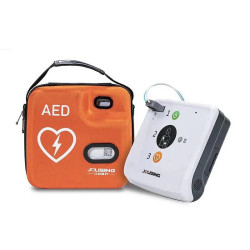
Tecnoheart Plus Defibrillator
- Exceptional operational readiness
- The ultimate expression of versatility is found in automatic AED defibrillators.
- These models manage all operations autonomously, informing the rescuer of the activities performed by the device.
- Shock delivery is SEMI-AUTOMATICO, with the operator's intervention following a verbal warning from the system.
Strategic placement of the device
Placing defibrillators where they are easily visible and accessible is the first step toward an effective and timely response.
Reduce the time to first shock delivery
- The goal is to deliver the first shock within 4 minutes.
- TecnoHeart Plus and its features ensure exceptional operational readiness.
Universal defibrillator
- Adult and pediatric selector without the need to change the pads
- Defibrillator designed to operate in accordance with version 2010 of the guidelines established by AHA/ERC concerning Cardiopulmonary Resuscitation (CPR) and Emergency Cardiovascular Care (ECC).
Guided voice instructions for responding
- A voice guides you throughout the entire response.
Features
- Cover: the cover protects the action icons, the patient mode button, and the shock button.
- Status indicator: the status indicator shows the unit's status, temperature, and battery level.
- Electrode connector: the electrode connector is used to connect the electrodes.
- Action icons: the LED indicator flashes red beneath the corresponding action icon.
- Patient mode switch: Once the user has identified the patient by type, select the patient mode—adult or pediatric—using the patient mode switch.
- Shock button: once preparation for the electrical shock is complete, the shock button will flash. Press the shock button to deliver the electrical shock.
- Sliding button: the sliding button is used to open the cover; to switch on the device, push the sliding button to the right.
- SD card slot: the SD card is used to save data and update the AED firmware.
- Infrared communication port: the infrared communication port is used to communicate with a PC.
TECNOHEART THE LIFE-SAVING DEVICE
• Voice guidance: for simple, assisted use.
• SD card: activity storage for legal protection.
• Soft case: protection against impacts and scratches.
• Long-life LiMnO2 battery: 5 years, 200 shocks.
• Battery indicator: lets you check the battery level at any time.
• Critical component self-tests: ensure that the equipment functions efficiently.
• Impedance calculation: verifies the integrity of the AED's contact with the patient.
• Display screen: lets you read the instructions if you are unable to hear the voice guidance.
• Biphasic shock: an electrical discharge that passes through the heart first in one direction and then in the other.
• Heart On software: used to systematically archive AED usage data and to update the firmware.
• Pre-connected electrodes: reduce response times.
• Battery: 200 electrical shocks
• IrDA communication port: enables communication between the PC and defibrillator
• Variable energy: adult (>25 kg), from 185 to 200 J; pediatric
WHY USE A DEFIBRILLATOR?
- ETHICS: Ethics is the set of objective and rational principles that make it possible to assign a deontological status to human conduct, that is, to distinguish it as good, just, or morally permissible, as opposed to conduct considered bad or morally inappropriate. Being equipped and making life-saving devices available is a deontological imperative that transcends any other consideration.
- AWARENESS: The term awareness refers to human perception and cognitive response when a particular event occurs. The percentage of sudden deaths from cardiovascular causes is, on average, more than 50% of all deaths.
- OBLIGATION: The term obligation, used in everyday language as a synonym for duty, has a more specific meaning in law: it designates the legal position of a person required to behave in a certain way as prescribed by a rule in the interests of other people. Many facilities are required to possess life-saving devices, and this has become, “de facto,” an obligation in healthcare settings where the type of professional practice exposes the population to cardiovascular risk.
WHAT IS CARDIAC ARREST?
Cardiac arrest is the sudden cessation of the heart's pumping function, which leads to death if not treated appropriately and promptly.
Cardiac arrest can be caused by various factors, but in most cases it is attributable to ischemic heart disease.
A person is experiencing cardiorespiratory arrest when they:
-are unconscious;
-are not breathing spontaneously (or are gasping);
-have no detectable pulse in the carotid artery.
The presence of either one of the two signs is enough to begin the BLS (Basic Life Support) sequence. Although the term
cardiac arrest is often used as a synonym for sudden death, it is better to use the term cardiac arrest to indicate the sudden loss of heart function.
In fact, cardiopulmonary resuscitation (CPR) maneuvers, when performed promptly and correctly, can reverse cardiac arrest and thus bring the patient back to life.
Cardiac arrest is the commonly used term, but it would be more accurate to speak of cardiorespiratory arrest (CRA), since respiratory and cardiovascular function are closely interconnected, and cessation of either is rapidly followed by arrest of the other.
In fact, primary circulatory arrest is rapidly followed by respiratory arrest; conversely, cessation of respiratory activity is invariably followed by rapid deterioration of cardiac activity, resulting in cardiac arrest.
Sudden cessation of circulation is followed within 30-45 seconds by respiratory gasping, apnea, and the onset of pupil dilation; within a further 45 seconds, the pupils dilate completely.
When the initial event is respiratory arrest, the blood becomes progressively depleted of oxygen, and within a few minutes asystole or ventricular fibrillation develops, resulting in cessation of the heart's pumping activity.
It is therefore clear that resuscitation measures for each of these two emergencies must include both ventilation and circulation.
TIME IS A CRITICAL FACTOR
Many studies have demonstrated the importance of the time between collapse and defibrillation, and the effects of cardiopulmonary resuscitation (CPR) performed by bystanders on the survival of a person experiencing ventricular fibrillation.
Every minute between collapse and defibrillation reduces the chances of survival for victims of cardiac arrest and ventricular fibrillation by 7 to 100% if cardiopulmonary resuscitation is not performed.
Ventricular fibrillation rarely returns to normal spontaneously.
The intervention of a defibrillator is essential to save a life.
Make sure you have one available when you need it.