The spray nozzle is supplied 1 pc for every 2 bottles.
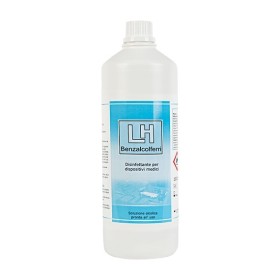
LH Sinersan Spray is a ready-to-use hydroalcoholic solution with broad-spectrum disinfectant and cleaning action, consisting of a synergistic combination of various biocidal agents. For the rapid and effective disinfection of medical devices, hospital and outpatient-clinic equipment (instrument shelves, lamps, trolleys, basins, furniture, wheelchairs, beds, treatment-chair units, etc.).
CE MEDICAL DEVICE 0051: CLASS IIb
Ingredients:
100 g of solution contain:
- Benzalkonium chloride 0.10 %
- Didecyldimethylammonium chloride 0.07 %
- Chlorhexidine digluconate 0.05 %
- Ethyl alcohol 52.0* %
- Co-formulants and purified water q.s. to 100 %
* Equivalent to 52% w/w and 58% v/v ethyl alcohol.
Product characteristics:
Ready-to-use hydroalcoholic solution with disinfectant and cleaning action, bactericidal, virucidal and fungicidal, consisting of a synergistic combination of various biocidal agents.
- Appearance: Clear, colourless liquid
- Odour: Citrus
- pH: 6.20 ± 0.50
Areas of use:
Rapid and effective disinfection, deodorisation and cleaning of medical devices, hospital and outpatient-clinic equipment (instrument shelves, lamps, trolleys, basins, furniture, wheelchairs, beds, treatment-chair units, etc.).
Disinfection and decontamination of contaminated instruments before sterilisation; to prevent the spread of microorganisms during the collection of infected materials.
Instructions for use:
Use undiluted, spraying it so as to completely cover the surfaces and objects to be treated.
The solution evaporates quickly. Rinsing is not necessary; dry any residue with clean, dry paper or a cloth.
Leave in contact for at least 3 minutes.
Mechanism of action:
At relatively low concentrations, chlorhexidine has a bacteriostatic action, whereas at higher concentrations its action is rapidly bactericidal. The lethal process has been shown to consist of a series of related physiological and cytological changes culminating in cell death. In particular, the hypothesised sequence is as follows:
- Rapid attraction to the bacterial cell
- Specific and strong adsorption to certain compounds containing phosphate groups on the bacterial surface
- Resistance to the exclusion mechanism of the bacterial cell wall
- Attraction to the cytoplasmic membrane
- Release of low-molecular-weight cytoplasmic components (e.g. potassium ions) and inhibition of certain membrane-bound enzymes such as adenosine triphosphatase
- Precipitation of the cytoplasm through the formation of complex salts with phosphorylated entities such as adenosine triphosphate and nucleic acids
Quaternary ammonium compounds have a mechanism of action similar to chlorhexidine but differ substantially in their interaction with the cell envelope.
The outermost surface of bacterial cells generally has a negative charge, often stabilised by divalent cations such as Mg2+ and Ca2+. Cationic antimicrobials often require only a strong positive charge together with a hydrophobic region in order to interact with the cell surface and integrate into the cytoplasmic membrane. Such integration into the membrane is sufficient to disrupt its growth and, at the treatment levels associated with disinfectant and antiseptic formulations, is sufficient to cause a loss of fluidity, resulting in cell death. The mode of action of quaternary ammonium compounds against bacterial cells is understood to involve a general disruption of the lipid bilayer that makes up the bacterial cytoplasmic membrane and the outermost membrane of gram-negative bacteria. This action leads to a general and progressive release of cytoplasmic material into the external environment. Virucidal action occurs on the protein and/or lipid envelope of the virus, which contains and protects the genetic material, inactivating it.
Finally, due to its multiple mechanisms of toxic effect, ethyl alcohol can be considered a non-specific antimicrobial. The primary microbicidal mode of action of alcohol is linked to its coagulating/denaturing effect on proteins. Alcohol-induced protein coagulation involves the cell membrane, the cytoplasmic membrane and the various plasma proteins. Coagulation of enzyme proteins leads to a loss of cellular functions. Alcohols target the bacterial cell membrane, resulting in lysis and release of cellular contents.
!! WARNING !!
The spray nozzle is supplied 1 pc for every 2 bottles.
1 bottle of 1000 ml